Pokies Parlour Casino Australia: How It Works
 Available in US
Explore venue operations, machine basics, state and territory rules, promotions, reviews, and the legal position of online play.
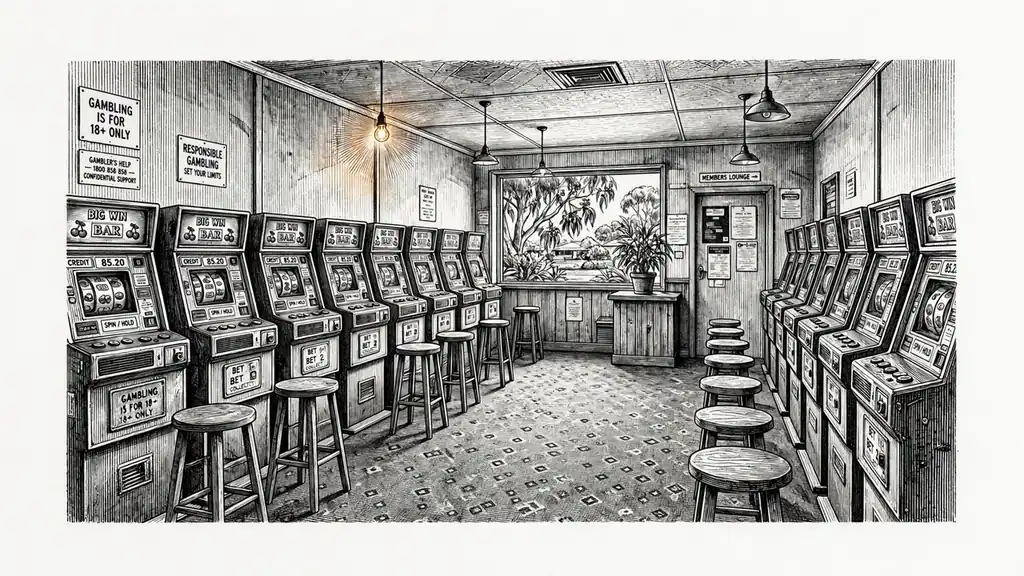
Table of Contents
- What a Pokies Parlour Is and How the Machines Work
- Pokies Parlours in Australia: Venues, Locations, and Local Context
- How Australian Pokies Venues Operate Day to Day
- Australian Rules by State and Territory: What Changes at the Venue
- Bonuses, Deposits, and Sign-Up Offers: Read the Conditions First
- Free Spins, Free Chips, and Real-Money Play Explained
- VIP Parlour Programs and the Limits of Loyalty Rewards
- Pokies Parlour Reviews: What to Check Before You Play
- Pokies Parlour Casino Play Online: The Legal Reality in Australia
- No-Deposit Pokies Claims and Safer Choices
What a Pokies Parlour Is and How the Machines Work
A pokies parlour is a physical business establishment where customers play electronic games for money. Its main attraction is a large bank of digital gaming machines, often called pokie machines in Australia. Unlike a land-based casino built around many table games, a pokies parlour is centred on electronic play: you sit at a machine, choose a game, and make selections through the screen or controls.
The word “parlour” describes the venue, not a particular machine or game. A pokies parlour casino may contain a broad selection of electronic gaming machines arranged across one room or several connected areas. The machines are the venue’s central attraction and its primary source of revenue. Drinks, food, or other facilities may exist in the same business, but they do not change the basic purpose of the gaming area.
What an electronic gaming machine does
An electronic gaming machine, or EGM, is a computer-controlled gambling device that produces games of chance. It may use reels, cards, numbers, symbols, or combinations of these elements. The outcome is generated electronically, while the display presents the result in a form that is easy to follow.
This shortlist highlights online casino options relevant to the Australian pokies market in 2026. Use the listed licensing, bonuses, deposit requirements and payout details to identify which offers best match your priorities.
License: Curacao – Antillephone N.V. (Versus Odds B.V.) · Bonus: up to EUR 2,000 across 5 deposits + 200 free spins · Min. deposit: EUR 20 Thor Casino operates under a Curacao Antillephone N.V. licence through Versus Odds B.V. Its offer includes up to EUR 2,000 across 5 deposits and 200 free spins, with a EUR 20 minimum deposit.
License: Curacao Gaming Control Board (TechSolutions Group N.V.) · Bonus: 100% up to A$250 + 100 free spins (1st deposit) Bizzo Casino is licensed by the Curacao Gaming Control Board through TechSolutions Group N.V. New players can claim 100% up to A$250 plus 100 free spins on the first deposit.
License: Curacao eGaming Licence · Min. deposit: A$10 Royal Reels operates under a Curacao eGaming Licence. Its A$10 minimum deposit makes it notable for players looking for a low entry point.
License: Curacao eGaming Licence · Min. deposit: A$10 King Billy operates under a Curacao eGaming Licence. The casino has a A$10 minimum deposit.
Bonus: up to A$750 + 50 jackpot spins, 35x wagering · Payout speed: crypto ~90 minutes, fiat 1-5 days · Min. deposit: A$30 Kingmaker offers up to A$750 plus 50 jackpot spins, with 35x wagering. Payouts are stated at around 90 minutes for crypto and 1–5 days for fiat, while the minimum deposit is A$30.
License: Curacao Gaming Control Board OGL/2023/176/0095 (Hollycorn N.V.) · Bonus: up to A$1,500 + 200 free spins across 3 deposits LuckyVibe is licensed by the Curacao Gaming Control Board under OGL/2023/176/0095 through Hollycorn N.V. Its promotion provides up to A$1,500 plus 200 free spins across 3 deposits.
License: Curacao · Bonus: up to A$2,000 Golden Pokies operates under a Curacao licence. Its main promotional feature is a bonus of up to A$2,000.
License: Curacao Gaming Control Board · Bonus: up to A$5,000 + 400 free spins JustCasino is licensed by the Curacao Gaming Control Board. The advertised offer reaches up to A$5,000 and includes 400 free spins.
Bonus: 100% up to A$750 + 200 free spins, 35x wagering · Payout speed: crypto 30-120 minutes, fiat 24-72 hours · Min. deposit: A$30 MrPacho offers a 100% bonus up to A$750 plus 200 free spins, with 35x wagering. Crypto payouts are listed at 30–120 minutes and fiat payouts at 24–72 hours; the minimum deposit is A$30.
License: international iGaming licence – jurisdiction not named in the source · Bonus: 100% up to A$1,000 + 100 free spins, 35x wagering · Payout speed: PayID 1-24 hours · Min. deposit: A$30 (PayID from A$10) House of Pokies holds an international iGaming licence, although the source does not name the jurisdiction. It offers 100% up to A$1,000 plus 100 free spins with 35x wagering, while PayID payouts are stated at 1–24 hours and the minimum deposit is A$30, or A$10 when using PayID.
The machine may resemble a traditional slot, but EGMs can also imitate classic casino games such as poker or keno. Some offer distinctive themes and variations rather than reproducing a single old-style format. The title, artwork, sound, bonus features, and controls can differ substantially from one game to another, even when the underlying activity remains electronic gambling.
A typical session begins when you sit at a machine and provide funds. Depending on the venue and machine, this may involve coins, notes, or a card-based payment method. You then select the game settings available on that machine and start the electronic game. The screen shows the result and any corresponding credit or prize information. The exact controls vary, so the machine’s instructions matter more than its appearance.
Classic slots and video-based games
Classic slot machines are the simplest format to recognise. They generally present reels with symbols and use a straightforward spin-based layout. The design may borrow from familiar fruit, number, or casino imagery, but the important feature is the limited, reel-focused presentation.
More complex video games use the screen for much more than displaying spinning reels. They can include modern graphics, animated sequences, multiple screens, character-based themes, and storylines. A video game may still use reels as its core mechanism, or it may imitate poker, keno, or another game of chance. Extra visual features do not turn it into a skill game. They make the presentation more elaborate.
This distinction is useful when you are comparing parlour pokies. A machine with a dramatic theme and several feature screens may look very different from a classic slot, yet both remain electronic gaming machines played for money. The artwork and storyline describe the presentation; they do not, by themselves, explain the odds, rules, or possible outcomes.
Choosing among parlour pokies
Pokies parlours can offer hundreds of different pokie machines, with differences in themes, stakes, and reward systems. That range can make the room appear more varied than it is: many machines use familiar structures while changing the graphics, symbols, or feature design. Read the instructions displayed on the individual machine rather than assuming that two cabinets work in the same way.
The available stake settings are part of the machine’s design. A lower denomination does not make a game free, and a higher denomination does not make it a different type of gambling. It changes how the machine accepts and applies the selected play. Reward systems also vary. A screen may describe winning combinations, feature rounds, or other in-game outcomes, but those descriptions should be treated as rules for that machine, not as a promise of a return.
Terms such as “free play” or “free spins” can be misleading when removed from context. A feature may refer to an in-game event or promotional wording rather than cost-free access to a real-money gaming session. The machine’s displayed rules and the venue’s conditions determine what the offer actually means.
What “play” means in this setting
When people use phrases such as “pokies parlour play” or “pokies parlour casino free”, they may be referring to different things: learning how a machine works, trying a demonstration mode, or looking for a money-based game without a deposit. Those are not interchangeable. A physical pokies parlour provides electronic games for real-money play, and the machine’s operation begins only within the conditions set by the venue and the game.
The same distinction applies to a “pokies parlour bonus”. A visual feature, a machine event, and a separate venue offer are different matters. Do not assume that a label on the screen represents cash, a guaranteed reward, or unrestricted play.
Legal Distinction Australian land-based venues and online casino services are not interchangeable, and online casino games are prohibited for Australian customers under the Interactive Gambling Act 2001.
A pokies parlour is therefore best understood as a physical gaming environment built around electronic machines. Some are simple reel-based slots; others are video-led games with detailed themes and storylines. In every case, the sensible starting point is the machine’s own rules: what game is being offered, how funds are entered, what selections are available, and how the displayed result is defined. That basic model is separate from online casino play, which has a different legal status in Australia.
Pokies Parlours in Australia: Venues, Locations, and Local Context
Pokies parlours are part of Australia’s established land-based entertainment landscape. They have been a familiar feature of local entertainment scenes in Australia and New Zealand since the 1990s, although the setting is not always a standalone venue with “parlour” in its name. In Australia, a place described as a pokie parlour casino may instead be connected with a hotel, bar, restaurant, or community club.
That distinction matters when you are trying to understand what a venue actually is. A pokie parlour is best understood by its physical setting and purpose, not by a particular sign above the entrance. Some locations are designed around electronic gaming, while others combine pokie machines with food, drinks, social areas, or accommodation. The gaming area is part of the venue’s offer, but the surrounding business helps determine how the place fits into local life.
Where pokie parlours are found
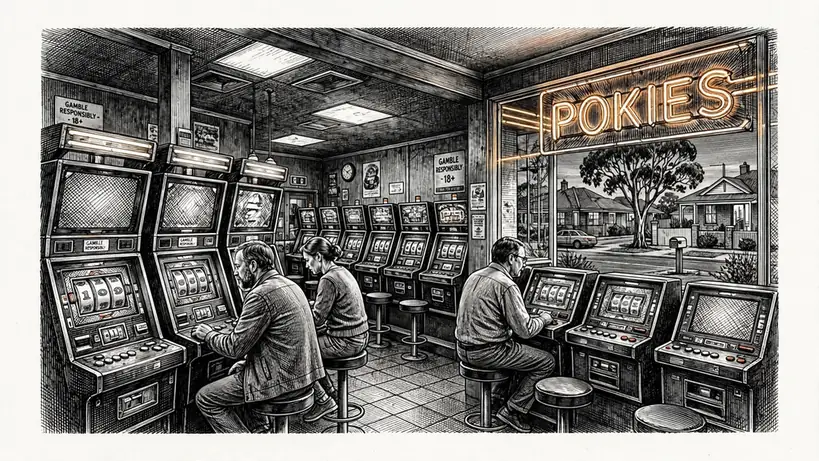
Pokies parlours are commonly found in urban areas, where established hospitality and entertainment businesses provide a natural setting for them. A venue may sit within a busy commercial district, near other restaurants and bars, or in a suburban area serving local residents. In these settings, the parlour is part of an existing pattern of leisure activity rather than an isolated destination.
They can also be found along highways and near major intersections. These locations are practical for businesses that serve passing traffic as well as nearby communities. A highway venue may be attached to a hotel or restaurant, giving visitors a place to stop for food or refreshments alongside access to the gaming area. Near a major intersection, visibility and convenience can connect the venue with several surrounding suburbs or transport routes.
Location alone does not tell you what kind of experience to expect. An urban venue may be integrated into a larger hospitality complex, while a roadside location may have a stronger connection to travel and accommodation. A community-based venue can have a different atmosphere again. The same phrase, pokie parlour, therefore covers several physical contexts.
The connection with hotels, bars, and restaurants
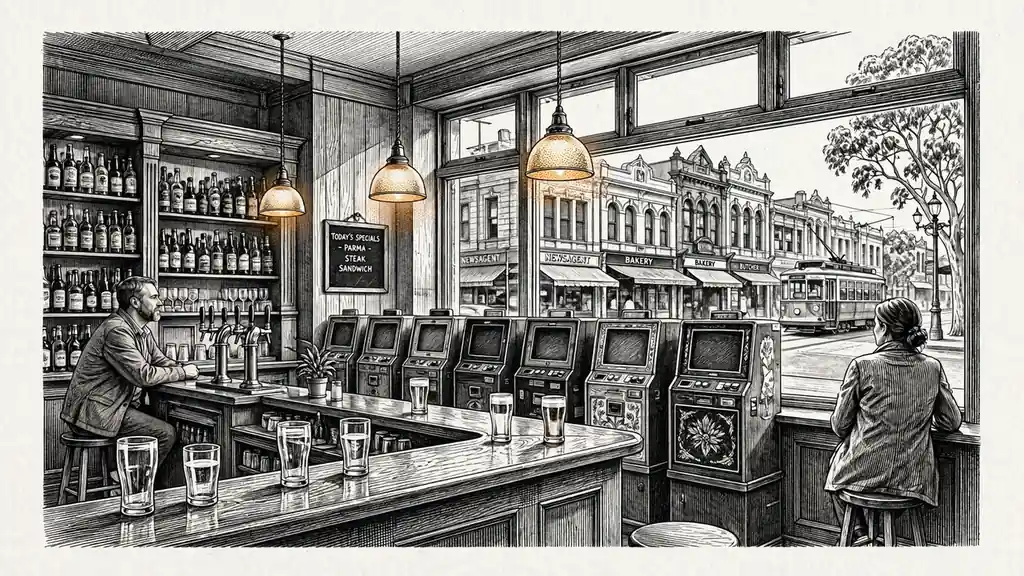
Pokie parlours are often attached to bars, hotels, restaurants, or community clubs. This arrangement places gaming within a broader hospitality business. You might enter through a shared building, use common customer areas, or find the gaming section positioned beside food and drink facilities. The boundaries can be obvious in one venue and less obvious in another.
Hotels are a particularly important part of this local model. In Australian usage, a hotel can function as a hospitality venue rather than simply a place providing rooms. A gaming area may sit alongside a bar, dining room, or other customer facilities. That makes the venue part of the everyday social infrastructure of a neighbourhood, not only a destination for people specifically seeking a parlour casino.
Restaurants can provide another point of connection. A venue that combines dining and gaming may attract customers for different reasons, with some visiting for a meal and others using the gaming area. Bars can serve a similar role, linking the parlour with an established evening or social setting. These combinations also explain why a listing or advertisement may describe a venue by its hospitality identity rather than using the term pokie parlour.
Located in busy commercial districts, near restaurants, bars, or suburban residential areas.
Practical for serving passing traffic, often attached to hotels or roadside restaurants.
Gathering places for members where gaming is integrated with social and club activities.
Community clubs add a further local dimension. They can serve as gathering places for members and residents, with gaming located alongside social and club activities. The presence of a pokie parlour in such a setting does not mean every visitor has the same purpose. Some may be attending for the club environment, food, or an organised activity, while others are there to use the machines.
A local rather than uniform market
Australia does not have one single physical venue format. The location, attached business, and surrounding community all shape how a pokie parlour operates as a place. An inner-city venue may be part of a dense entertainment area. A suburban club may function as a regular local meeting point. A roadside hotel may be more closely associated with travel, meals, and accommodation.
This variety is one reason broad labels can be misleading. Calling a venue a parlour casino does not tell you whether it is independent, attached to a hotel, situated inside a club, or combined with a restaurant. It also does not indicate the atmosphere, accessibility, or services available outside the gaming area. Those details belong to the venue itself and should be confirmed locally rather than inferred from the label.
The physical market is also different from an online casino. A land-based venue has a real address, a defined building, and a relationship with nearby businesses or community facilities. You can identify whether the gaming area is part of a hotel, bar, restaurant, or club. That physical context is central to the Australian meaning of pokie parlour casino and should not be blurred with online terminology.
How to read the setting before visiting
Start with the venue’s actual location. An urban address, highway position, and community-club setting each suggest a different surrounding environment. Check whether the venue is attached to another business and whether the listed address describes the gaming location rather than a general hospitality brand.
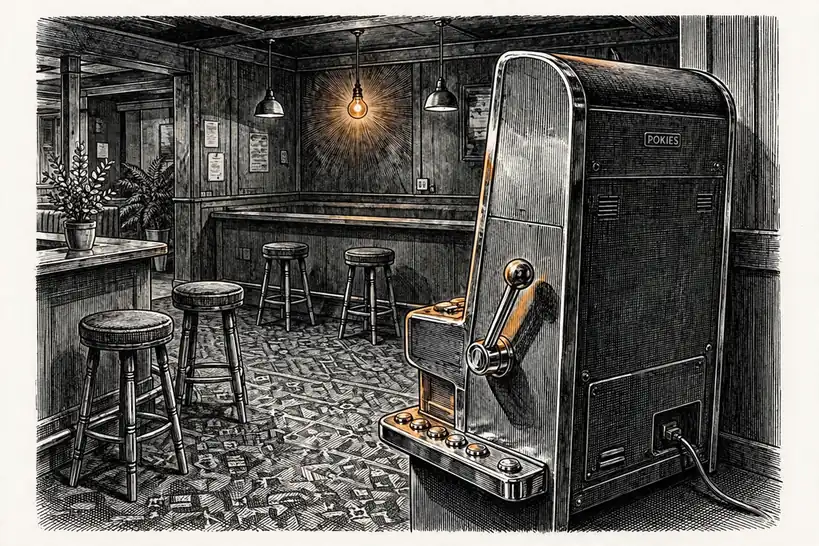
Next, consider the role of the attached business. A hotel, restaurant, bar, or community club may provide services and facilities that sit outside the gaming area. The venue’s name may emphasise those services, so look for a clear description of where the pokie machines are located within the building.
It is also sensible to distinguish a venue’s physical identity from promotional language. Terms such as “casino” can be used loosely in marketing, but the important question is whether you are looking at a land-based pokie venue in Australia and what kind of business surrounds it. A polished name does not change the local context.
Pokies parlours have remained visible in Australian communities because they are embedded in familiar hospitality and club settings. Their locations range from urban areas to highways and major intersections, while their connections with hotels, bars, restaurants, and community clubs give each venue a distinct place within the local entertainment landscape.
How Australian Pokies Venues Operate Day to Day
Australian Rules by State and Territory: What Changes at the Venue
Pokie parlours operate under local laws, and gaming-machine rules are mainly controlled by Australia’s individual states and territories. That means the conditions applying at one venue may not apply at another, even when both offer pokie machines. Check the local requirements for operating hours, machine location, bet limits, and Return to Player (RTP) before playing.
The ACT provides one example of a tightly defined venue model. A regulatory overview reports 5,200 gaming machines in the territory, all located in clubs and hotels. The same overview states that ACT clubs and hotels have a five-hour gambling break, do not operate around the clock, and apply a maximum gaming-machine bet of $10 per spin. It gives the ACT minimum RTP as 87%.
ACT Limits $10 max bet; 87% min RTP; 5-hour gambling break
NT Limits $5 max bet (clubs/hotels); 85-88% min RTP
NSW Limits $10 max bet (clubs/hotels); No limit in casinos
The Northern Territory uses different limits depending on the venue type. A regulatory overview reports 2,195 gaming machines in clubs, hotels, and two casinos. It states that clubs and hotels have a $5 maximum bet per spin, while casinos have no bet limit. The minimum RTP is reported as 85% in clubs and hotels and 88% in casinos.
New South Wales illustrates the scale and variation of another market. A regulatory overview reports 100,500 gaming machines in clubs, hotels, and The Star Casino in Sydney. It states that clubs and hotels have a $10 maximum bet per spin, while the casino has no limit.
These examples are not a substitute for checking the venue’s current local conditions. They show why a pokie parlour should be assessed by its state or territory, its venue category, and the rules displayed on the premises. Operating hours, maximum bets, RTP, machine placement, game rules, and compliance obligations can all depend on that local framework. Age restrictions, harm-minimisation measures, self-exclusion arrangements, and gambling-support information also form part of responsible venue operation.
Bonuses, Deposits, and Sign-Up Offers: Read the Conditions First
Words such as “sign-up bonus”, “deposit bonus”, and “no-deposit offer” can describe very different arrangements. In a pokies parlour, they may refer to a venue loyalty benefit, a points-based reward, or language imported from online gambling advertising. The label alone tells you little about the value, eligibility, or legal setting of the offer.
The first distinction is between money used for play and a promotional benefit. Customers fund a digital account and use those funds to play electronic games. A bonus does not automatically change that underlying arrangement. It may add credit, points, access, or another benefit, but the conditions determine what can actually be used, when it can be used, and whether anything can be withdrawn or exchanged.
What “sign-up bonus” can mean at a physical venue
A sign-up offer at a physical pokies parlour may be connected to joining a customer or loyalty programme. The benefit could involve points, access to venue features, or a non-cash reward. It should not be treated as guaranteed cash or as a promise of a winning outcome.
A profile review of the sector describes some establishments as offering points programmes and loyalty rewards that may be exchanged for in-game virtual items or non-monetary perks such as higher jackpots. That is a description of one source’s account, not a universal feature of every Australian venue. Ask the venue what the programme actually provides rather than assuming that “bonus” means withdrawable funds.
Before joining, check:
- whether registration is required;
- whether the offer is available to all eligible customers or only to selected members;
- whether the benefit is credited as cash, points, machine credit, or a non-monetary perk;
- where the benefit can be used;
- whether it expires or is subject to other conditions;
- whether identification or age verification is required;
- whether the venue can change or withdraw the offer.
The last point matters because promotional language often gives the headline benefit more space than the restrictions. A short phrase such as “join and receive a bonus” may leave the important details in separate terms.
Deposit bonuses are not free money
A deposit bonus is normally linked to funds placed into an account. Since players deposit funds into digital accounts before using electronic games, the deposit requirement is central to understanding the offer. If the promotion requires you to add money first, it is not a no-deposit offer, even if the advertising gives greater prominence to the bonus than to the payment condition.
Read the wording in sequence:
- What must you do to qualify?
- What form does the benefit take?
- Which games or machines accept it?
- Can it be used immediately, or must another condition be met?
- Can it be transferred, exchanged, or withdrawn?
- What happens if you stop using the account?
- Which terms apply if the venue changes the promotion?
Do not infer an answer from the promotional heading. “Extra play”, “welcome credit”, and “member reward” may sound similar while creating different rights. If the terms do not explain the benefit clearly, the safer interpretation is that its value has not been established.
The problem with “no-deposit” wording
“No deposit” can mean that no initial payment is needed to receive a promotional item, but it does not necessarily mean that you can play unrestricted real-money games without funding an account. It may refer to a trial feature, a venue invitation, a loyalty entitlement, or a claim made by an online operator. Those are materially different situations.
For a physical pokies parlour, ask what the phrase means in the venue itself. Is the offer connected to a membership account? Is it available only at certain machines? Is it a non-cash reward? Does it require a later deposit before any real-money play is available? A clear answer should come from the written terms or venue staff, not from the slogan.
- Read the specific machine’s instructions and rules.
- Check the venue’s local terms and conditions.
- Verify the physical location and attached business.
- Assume a “bonus” means withdrawable cash.
- Treat online terminology as applicable to physical venues.
- Assume all machines work the same way.
“No-deposit bonus” wording also needs particular care when it appears alongside “casino” language. Australian land-based venues and online casino services are not interchangeable. Australian-licensed online casinos do not exist, and online casino games are prohibited for Australian customers under the Interactive Gambling Act 2001. An online operator cannot make that legal position disappear by describing its offer as a sign-up reward or by using familiar pokies terminology.
Venue rewards versus online acquisition tactics
A physical venue may present a membership or points arrangement as part of its customer service. That does not make it equivalent to an online casino acquisition bonus. Online sign-up incentives are designed to attract customers to a remote gambling service, while a physical venue benefit may be tied to attendance, membership, or activity at that venue.
This distinction is important for Australian readers. Real-money online casino services are not domestically licensed, and no Australian gambling licence exists for casino games offered to Australian residents. A website using Australian wording, displaying familiar game names, or advertising a large welcome package is not thereby an Australian-licensed casino. There is no public Australian casino-licence register that can turn such a claim into proof.
Offshore operators may use deposit and no-deposit language aggressively, but the legal and consumer position remains different from that of a physical Australian pokies venue. The Interactive Gambling Act targets providers rather than players, so an Australian is not committing a crime merely by placing a bet at an offshore site. However, players using offshore casino sites have no recourse under Australian law if a dispute arises. That is the inconvenient part promotional banners tend to omit.
A practical way to assess an offer
Treat the offer as a set of conditions rather than as a headline. Save or request the full terms before providing personal details or depositing funds. Confirm the identity of the venue, the location where the offer applies, and whether the arrangement concerns a physical pokies parlour or an online service.
Then look for plain answers about:
- the qualifying action;
- the type of account involved;
- the form and value of the benefit;
- permitted games or machines;
- restrictions on use or exchange;
- expiry or cancellation terms;
- age and identity requirements;
- complaints and support channels.
Gaming machine rules and regulations are mainly controlled by individual Australian states and territories. That means an offer cannot be assessed only by reading national advertising language. The venue’s local setting may affect how machines, customer accounts, promotional activity, and harm-minimisation measures are managed. If the terms avoid naming the relevant physical venue or jurisdiction, treat that lack of detail as a reason to pause.
A genuine explanation should also distinguish promotional value from gambling value. A bonus cannot guarantee a return, change the chance-based nature of electronic games, or establish that a venue offers better value than another. Points and perks may have a use within a programme, but they are not evidence of a favourable outcome.
The most reliable reading is therefore the least glamorous one: identify what you must provide, what you receive, where it can be used, and what happens if the conditions are not met. If those answers are missing, “no deposit” and “sign-up bonus” are descriptions of advertising language, not proof that the offer is free, valuable, or suitable for you.
Understanding Offers
- Identify if the benefit is cash, points, or a non-monetary perk.
- Confirm if a deposit is required before use.
- Check the expiry date of the promotion.
- Verify which specific machines accept the offer.
Free Spins, Free Chips, and Real-Money Play Explained
Terms such as “free spins”, “free chips”, and “play free” can describe very different experiences. In a physical Australian pokies parlour, the central distinction is simple: entertainment without a money stake is not the same as playing an electronic gaming machine for real money. Promotional wording can blur that line, so read the offer as a set of conditions rather than as a promise of cost-free gambling.
What “free spins” may mean
Free spins generally refers to extra turns on a game without requiring a separate payment for each turn. That phrase alone does not establish that the spins are available at a physical pokies parlour, that they can be used on every machine, or that any resulting balance can be withdrawn. The conditions may instead connect the spins to a particular promotion, account, machine, or venue arrangement.
A free spin may also be presented as entertainment language rather than as a cash-equivalent benefit. If the feature is attached to a digital account, check whether you must first fund that account, whether the turns expire, and whether winnings can be transferred or used only within the venue’s system. Do not treat the word “free” as proof that no money is required anywhere in the process.
For a land-based venue, the practical question is where the feature is applied. Customers may sit at a machine, insert coins or notes, or use a card-based payment method before beginning play. A free-turn claim should therefore be clear about whether it changes the amount required to start the game or merely adds a feature after funds have been made available.
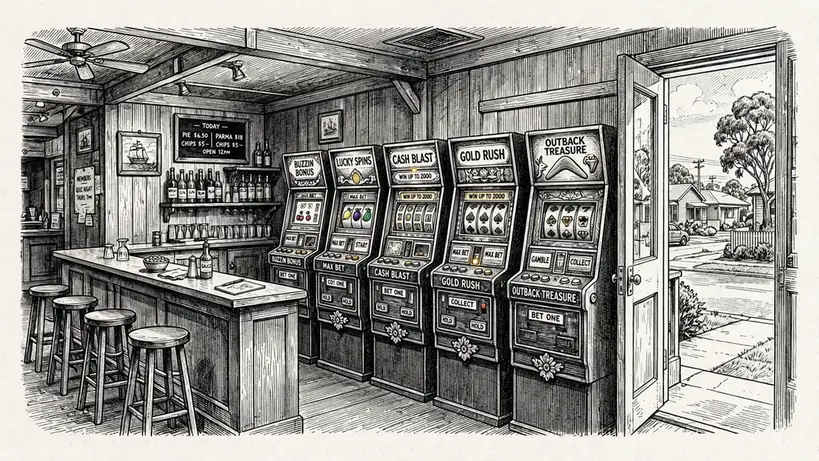
“Free chips” are not automatically cash
“Free chips” can sound like a direct gift, but chips may be promotional units, play credits, or another form of restricted value. They are not automatically equivalent to money that you can cash out. The terms should explain where they can be used, which games accept them, whether they can be converted, and what happens to any balance produced through them.
That distinction matters because pokies parlours offer electronic gaming machines for games of chance played with real money. A promotional chip or credit does not change the underlying nature of the machine. It may reduce the amount you personally provide for a particular play, but it does not create a guaranteed return or alter the chance-based result.
Be cautious when a claim uses “free chips” without identifying the issuing venue, the eligible machine, or the redemption process. A clear offer should not require you to infer whether the benefit is physical, digital, promotional, or simply descriptive wording for a game feature.
What “play free” should tell you
A play-free option can refer to a demonstration mode, an entertainment version, or promotional credits. In a demonstration mode, you may be able to view or operate a game without staking money. That can help you understand the interface, but it is not real-money play and does not establish that the same machine will produce a particular result when funds are used.
Play Free Modes Demonstration modes allow you to view or operate a game without staking money to understand the interface, but they do not establish the results of real-money play.
Promotional credits are different. They may allow play without an immediate cash insertion, while still being attached to an account or venue condition. Read the wording to determine whether you must deposit funds first, whether the credits are limited to selected games, and whether the balance has any cash value. If those points are missing, the phrase “play free” is too vague to support a financial decision.
A genuine no-cost demonstration should also be described honestly. It should not be presented as a way to withdraw winnings, and it should not imply that practising changes the odds of a later paid game. Free play can show how a machine operates; it cannot turn a game of chance into a predictable one.
Real-money play at a pokies parlour
Real-money play involves funds made available for electronic games of chance. Players deposit funds into digital accounts and use those funds to play electronic games. In a physical venue, the process may also involve inserting coins, notes, or using a card-based payment method at the machine.
This is the point at which promotional language stops being the main issue. You are no longer assessing an entertainment feature alone; you are deciding whether to use deposited money on a chance-based game. “Free spins” or “free chips” may reduce a particular payment requirement under stated conditions, but they do not remove the need to understand the game, the venue’s terms, and the money involved.
Keep promotional value separate from personal funds. Check whether the balance is cash, restricted credit, or a non-cash feature. Also check whether a claim applies to a physical pokies parlour rather than an online service. Australian-licensed online casinos do not exist, and online casino games are prohibited for Australian customers under the Interactive Gambling Act 2001. Offshore sites offer no recourse under Australian law if a dispute arises. A free-looking online offer is therefore not a substitute for a lawful Australian physical venue.
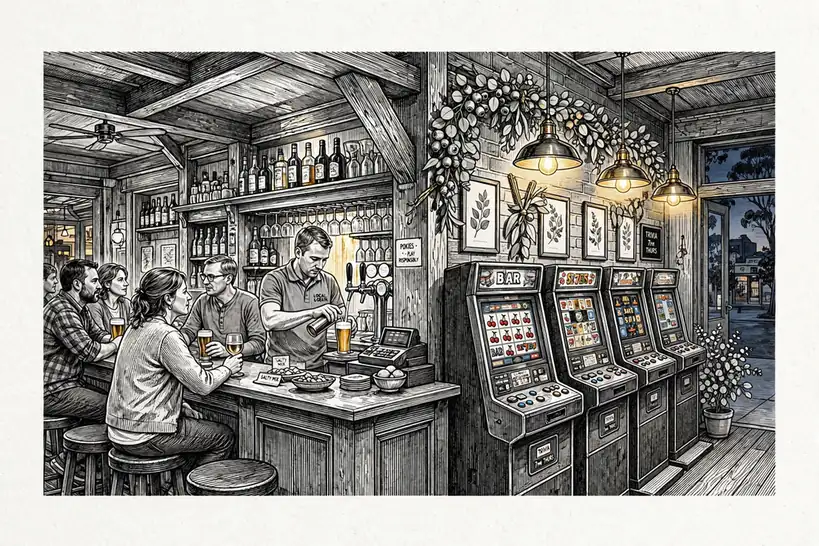
Before using any offer, confirm what you receive, what you must provide, and whether the benefit can actually be withdrawn. If the wording leaves those basics unclear, the safest interpretation is not that the play is free, but that the conditions have not been explained well enough.
VIP Parlour Programs and the Limits of Loyalty Rewards
A VIP programme at a physical pokies venue is a customer-loyalty arrangement, not a separate gambling product. Its purpose is to recognise visits or play activity and attach venue benefits to that relationship. The details can differ between clubs, hotels, and other establishments, so the programme’s own terms matter more than the VIP label.
A points structure may record eligible activity against a customer account. According to a specialist industry overview, some establishments allow points to be exchanged for in-game virtual items or non-monetary perks, including access to higher-jackpot games. That description should not be read as a market-wide promise. It does not establish that every Australian venue offers points, that every machine contributes to a balance, or that points have a cash value.
Before joining, check what the programme actually recognises and what redemption means. Useful distinctions include:
- whether points are linked to a named account, card, or venue app;
- whether rewards are virtual items, hospitality benefits, or another non-cash perk;
- whether the venue can change, suspend, or limit the arrangement;
- whether points expire or can be transferred;
- whether a VIP status changes access to machines without changing the game’s rules.
The last point is important. A loyalty benefit must not be confused with a guaranteed return. It does not turn a losing session into a profitable one, ensure a jackpot, or create a right to cash winnings. A higher-jackpot option is still a gambling feature, not a promised payout.
You should also keep VIP treatment separate from online casino advertising. Australia has no domestically licensed real-money online casino, and a physical venue’s loyalty programme is not evidence that an online casino is authorised to serve Australian residents. If a message uses VIP language to direct you to an offshore site, remember that disputes there have no recourse under Australian law.
Treat the programme as a venue convenience with conditions, not as a financial benefit. The clearest measure is whether you understand what is earned, what can be used, and what remains entirely uncertain.
Pokies Parlour Reviews: What to Check Before You Play
A useful pokies parlour review should help you assess a physical venue, not simply repeat promotional language. Start with information that can be checked on site or against the venue’s own displayed material. A polished description is not evidence that the machines, payment process, or support arrangements will suit you.
Venue Review Checklist
- Check the variety and denominations of the machine range.
- Understand the specific payment methods accepted (cards, coins, etc.).
- Confirm the availability of technical and staff support.
- Verify the displayed RTP and local game rules.
- Look for compliance signals and age requirement notices.
Check the machine range
The number and variety of pokie machines differ between establishments. A venue may have a broad selection, while another may offer a smaller group of machines with narrower stake options. Reviews should identify the range in practical terms: themes, denominations, reward systems, and whether the machines are classic-style games or more complex video formats.
Claims about “the biggest choice” are difficult to assess without supporting detail. A stronger review explains what was actually observed and avoids treating the presence of many machines as proof of better value. Hundreds of machines can still leave you with limited choices if the available stakes or game rules do not match what you want.
Examine payment information
A review should explain how funds are placed into play and how the venue handles the process. Customers may use coins, notes, card-based payment methods, digital wallets linked to venue apps, or mobile payments integrated through barcode scanning. The important point is whether the review distinguishes available methods from assumptions.
Look for clear information about where payment instructions appear, what support is available when a transaction does not work, and whether the venue explains the process before play begins. Avoid relying on a review that calls payments “easy” or “instant” without describing the method being assessed.
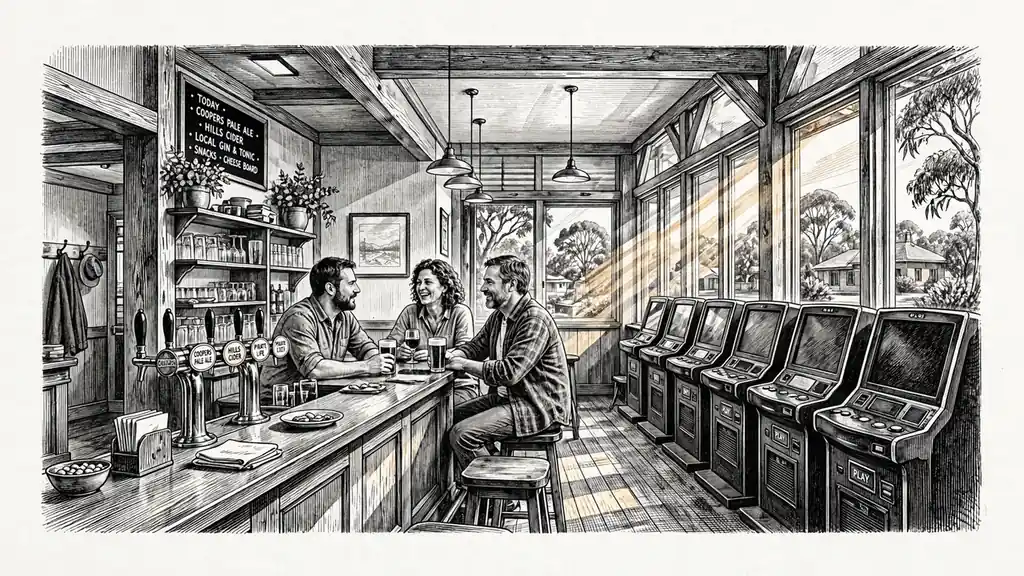
Assess technical support
Maintenance, updates, and troubleshooting are part of the venue experience. A credible review notes whether staff can explain a machine problem, how faults are handled, and whether assistance is visible or easy to request. Technical support should maintain gameplay without disrupting sessions, but no review can promise that every machine will operate without interruption.
The quality of the information matters here. A review based only on photographs cannot establish how staff respond to a fault. Treat first-hand operational detail as more useful than a general statement that the venue is modern or well managed.
Find the displayed RTP and game rules
Return to Player (RTP) is the stated long-run return measure for a game, not a promise that an individual session will produce a return. Check that the venue displays the RTP and the applicable game rules clearly. The rules should explain the relevant features of the machine rather than leaving you to infer them from graphics or advertising.
The displayed figure must also be read in its local regulatory context. For example, the ACT minimum RTP is 87%. That does not mean every Australian venue uses the same minimum, nor does it turn RTP into a prediction of your result. A review that quotes a return figure without identifying the venue and jurisdiction is incomplete.
Check local limits and compliance signals
Pokie parlours operate under local laws and regulations, so a review should identify the physical venue and avoid presenting one location’s conditions as a national standard. Check the applicable bet limits, permitted operating conditions, harm-minimisation measures, and age requirement at the venue itself.
Compliance Check Attention Always ensure the venue displays clear rules, RTP information, and mandatory harm-minimisation measures like self-exclusion options.
You should also expect the machines to display their rules and RTP. Missing or unclear information is a reason to pause rather than a minor inconvenience. The same applies when a review recommends a venue but gives no location, no explanation of how the information was obtained, and no indication that local requirements were considered.
A responsible review is therefore less concerned with declaring a “best” parlour than with showing what can be verified: machine choice, payment arrangements, technical assistance, displayed game information, and compliance signals. That makes it more useful than a rating built around atmosphere or promotional wording.
Pokies Parlour Casino Play Online: The Legal Reality in Australia
Searching for a way to play pokies online can blur two very different products: a physical Australian pokies parlour and a website operating from overseas. A land-based venue is a physical venue governed by the laws of the state or territory where it operates. Online casino play sits under a separate federal and state regulatory framework.
Australia has no domestically licensed real-money online casino. That means there is no Australian casino licence for websites offering online pokies, roulette, blackjack, or live dealer tables to Australian customers. Under the Interactive Gambling Act 2001, these services are prohibited interactive gambling services when offered to people in Australia. An operator should not offer Australian residents real-money casino play or use an online sign-up bonus to attract them.
This is different from online sports betting, which may be licensed under state and territory arrangements. A betting licence does not authorise online casino games, and an Australian wagering register is not a casino register. The distinction matters when a website presents several gambling products under one brand.
Some overseas websites may accept Australian players despite the restriction on providers. The law targets the provider rather than the individual player, so using an offshore site is not itself a criminal offence for an Australian customer. That does not make the service Australian, licensed locally, or protected by Australian consumer law. It also does not give you a domestic complaints route if a withdrawal, account, or game dispute arises. Players using offshore casino sites have no recourse under Australian law for such disputes.
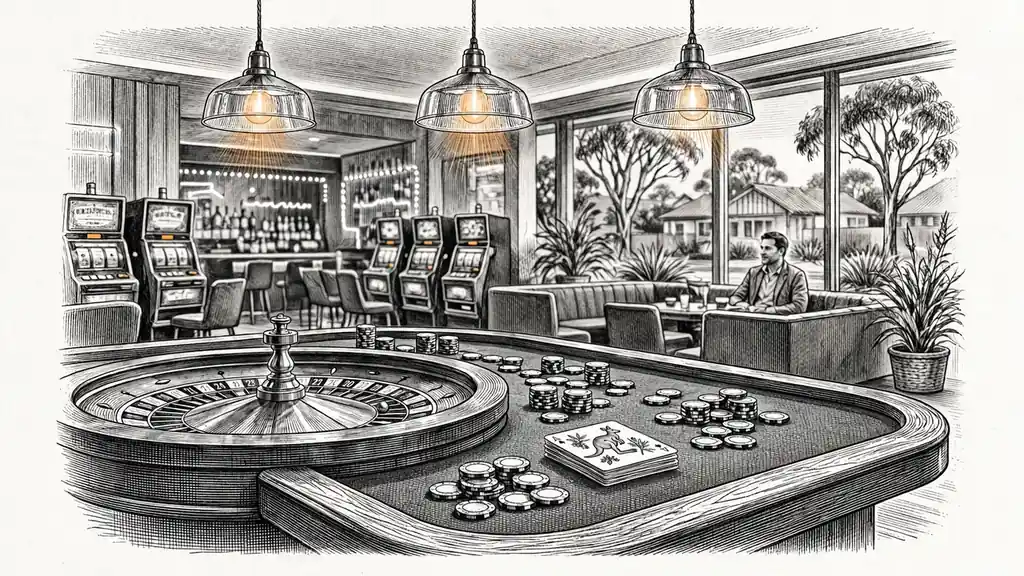
A pokies parlour therefore cannot be treated as the land-based branch of an Australian online casino. If a site claims to hold an Australian casino licence, offers online pokies to Australian residents, or presents a sign-up incentive as locally authorised, treat the claim with caution. The legal boundary is straightforward: physical venues operate under local rules, while Australian-licensed online casinos do not exist.
No-Deposit Pokies Claims and Safer Choices
A “no-deposit” pokies offer may sound like a way to play without putting money into a machine. In a physical Australian venue, treat that wording as a claim to investigate, not as permission to play for unrestricted free money. A customer normally begins by inserting coins, notes, or using a card-based payment method at the machine. Any departure from that process should be explained clearly by the venue.
Before relying on a claim, check where it comes from. A physical pokies parlour operates under local gaming laws, and the relevant rules are mainly controlled by the Australian state or territory in which the venue is located. Ask the venue to identify itself, explain the offer in writing, and state whether any funds, credits, conditions, or limited-use arrangements apply. Do not assume that language used by an overseas website describes an Australian physical venue.
Age is another basic safeguard. Pokies play is restricted to people aged 18 and over. A venue should also provide mandatory harm-minimisation measures, including self-exclusion and gambling-support information. If those arrangements are not visible or staff cannot explain them, that is a reason to stop rather than improvise.
Check the machine itself before inserting anything. The venue should clearly display the game rules and Return to Player (RTP) information. These details do not make a game profitable, but they show whether the machine and its conditions are being presented transparently. A free-play claim is not evidence of better odds, a guaranteed return, or a prize.
Finally, keep the legal distinction clear. Australian-licensed online casinos do not exist, and online casino games are prohibited for Australian customers. An offshore website’s “no-deposit” wording does not create Australian protection; players have no recourse under Australian law if a dispute arises. For a physical venue, rely on clear local information, understand the conditions, and use the venue’s self-exclusion or support options if play is becoming difficult to control.
Written by the editors at Casino Hub Au.